4.1 — Soil protection & policy
Why soil needs governance
Page 1 / 4
Why soil needs governance
Soils form slowly, often over centuries or millennia, yet they can be degraded within years, months, or even after a single poorly planned intervention. Processes such as erosion, sealing, contamination, compaction, and the loss of soil organic matter and biodiversity can reduce the capacity of soils to perform essential ecosystem services, including food production, water and climate regulation, biodiversity support, and cultural value.
In Europe, soil degradation remains a major environmental concern, with impacts on agriculture, water systems, climate mitigation, and biodiversity conservation (EEA, 2024). It also carries substantial economic costs, estimated at between €40.9 billion and €72.7 billion per year (Panagos et al., 2025). At the global scale, the Food and Agriculture Organization of the United Nations (FAO) and the Intergovernmental Technical Panel on Soils (ITPS) have highlighted that soil degradation is widespread and driven by processes such as unsustainable land use, intensive agriculture, deforestation, urbanisation, and pollution (FAO & ITPS, 2015; FAO, 2021).
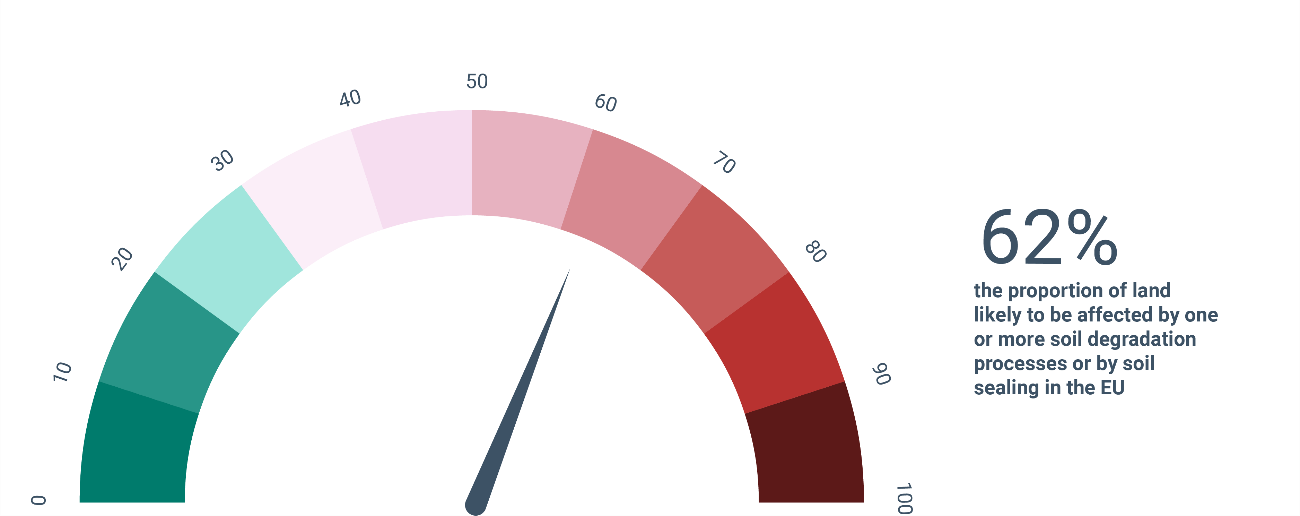
© Proportion of land likely to be affected by one or more soil degradation processes or by soil sealing in the EU, in Europe’s environment and climate: knowledge for resilience, prosperity and sustainability. European Environment Agency (2025).
Because soils support many ecosystem services, their degradation affects human well-being both directly and indirectly. Degraded soils may produce less food, store and filter less water, support fewer organisms, release stored carbon, and become less resilient to droughts, floods, and other climate-related pressures. For this reason, soil protection requires more than technical knowledge – it also requires governance systems that enable long-term, sustainable land management (Hannam, 2022).
One challenge is that soil degradation is often less visible than air or water pollution. Many changes occur gradually or below the surface, including compaction, declining organic matter, contamination, or loss of biological activity. By the time the impacts become obvious, essential soil ecosystem services may already be weakened. This relative invisibility has contributed to soil protection historically being more fragmented than protection frameworks for air or water.