2.4 — Soil diversity across land covers
Soil diversity and land covers
Page 4 / 6
Agricultural land
Do you know which crops are the most commonly grown in the area where you currently live? If not, do a quick web search in the web and find out.
What are agricultural soils like?
Agricultural land use has the main objective of producing food and other commodities for human and animal consumption. Some crops are also energy crops. Therefore, agricultural soils can be arable fields, orchards (perennial woody species), pastures grazed by livestock, or grassland cut to produce hay. The crop may require partial flooding (rice paddies and paludiculture) or tolerate only well-drained soils (potatoes). Agricultural soils are thus managed in very different ways.
Broad patterns in agricultural soils:
- Typically originally forest, grassland or peatland soils that have been cleared, planted or drained and then cultivated.
- Typically high soil organic matter content at the surface, decreasing with depth.
- Soil structure and organic matter are strongly affected by management (tillage, fertilisation, cropping system).
- Many regions now show widespread degradation from erosion, compaction, organic matter decline and pollution.
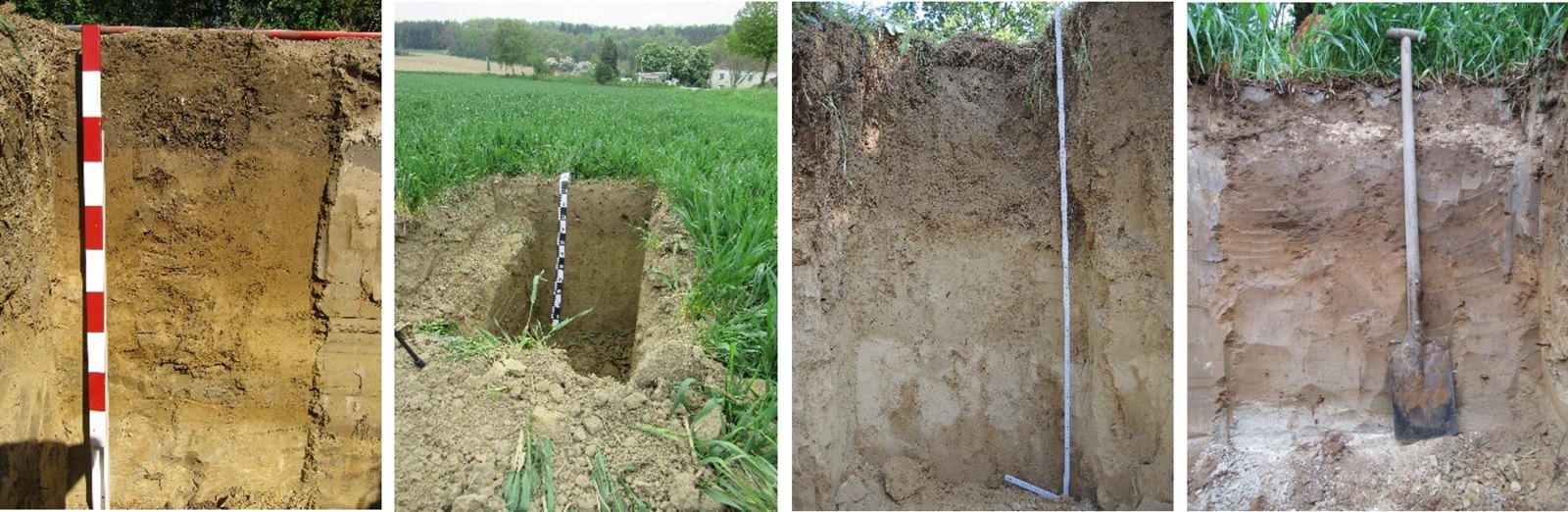
© Arable soils in Austria by Angelika Hromatka, BOKU University.
To find out more about impacts on agriculturally used soils, you can explore the articles by Bolinder et al. (2020) on the effects of crop residues, cover crops, manures and nitrogen fertilisation, and Mayel et al. (2021) on the impacts of management through grazing, mowing, and fertiliser input.
If you have not yet completed Module 3, browse the respective topics on soil organic matter decline and peatland degradation.