
4.1 — Soil protection & policy
Why soil needs governance
Página 2 / 4
Soil as a common resource
Soils are often managed locally: in a field, forest, garden, construction site, city park, or a riverbank. However, the effects of soil management rarely remain within those boundaries.
When soil is sealed in an urban area, less rainwater can infiltrate into the ground. As a result, more water runs over the surface, putting pressure on drainage systems and increasing flood risk elsewhere. When soil erodes from a field or forest road, sediments, nutrients, and pollutants can be transported into streams, rivers, reservoirs, and coastal waters. When soil organic carbon declines, soils store less carbon and contribute less toclimate regulation. When peatlands are drained, stored carbon is released, and water regulation changes across the wider landscape.
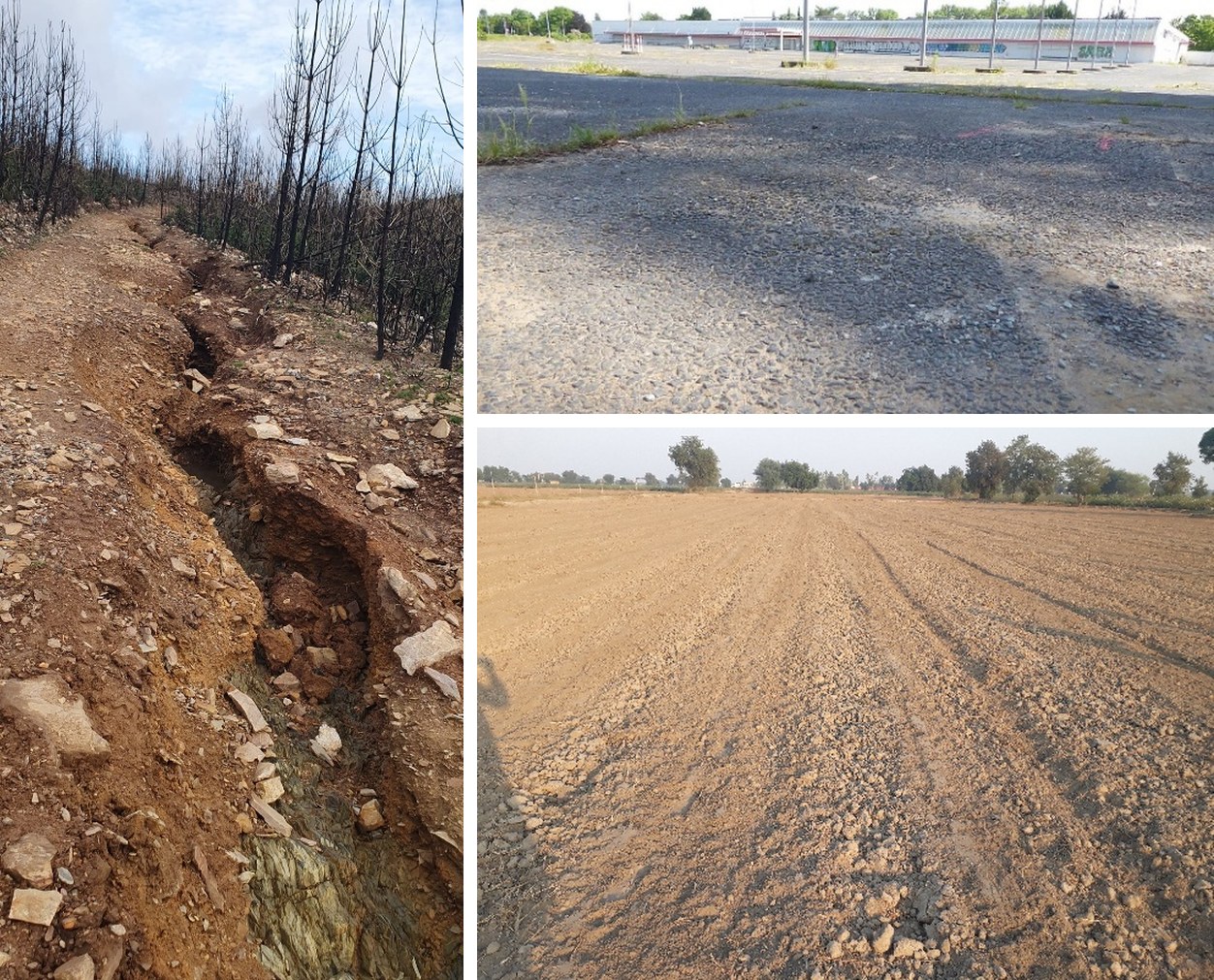
Left: © Forest road erosion by Martinho Martins, University of Aveiro
Upper right: © Soil sealing, by Rhetos, CC0 1.0, via Wikimedia Commons, no changes were made to the original photo.
Bottom right: © Tilled soil, by Mulkh Singh, CC BY 4.0, via Wikimedia Commons, no changes were made to the original photo.
These examples show why soil is both locally managed and publicly important. Soil may belong to one landowner or be managed by one institution, but the services it provides often extend far beyond that specific place.
This creates a governance challenge. Soil protection must balance private land management with public interests, scientific evidence, economic pressures, environmental limits, and social priorities. Decisions about soil therefore require coordination across different sectors, and levels of responsibility (Heuser, 2022; Peake & Robb, 2022).