
3.4 — Peatland degradation
Threats to peatlands
Page 3 / 6
A self-reinforcing process
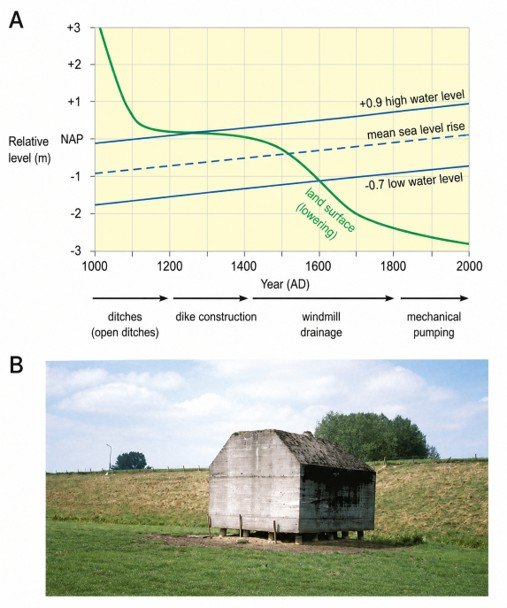
These processes initiated a cycle that would continue for centuries.
© Ground-level subsidence in the western Dutch peatlands. (A) Since around AD 1000, drainage has caused peat compaction and oxidation, resulting in progressive land subsidence. Successive improvements in drainage technology allowed the land to remain in use but also contributed to continued subsidence. (B) This process continues today. The bunker was built in 1940. Since then, the surrounding land surface has subsided by approximately 50 cm, exposing the tops of the foundation piles beneath the bunker (photo: G. Peek). Landschappen van Nederland.
The figure (panel A) illustrates how this process developed in the low-lying peatlands of the western Netherlands from around AD 1000 onwards. Initially, drainage through ditches caused rapid subsidence. Meanwhile, sea level continued to rise. As a result, by around 1200–1400 the difference between the land surface and surrounding water levels had become increasingly problematic, making conditions wetter again.
From around 1500, wind-powered polder mills made it possible to pump water out of the polders and lower water levels further. This allowed continued agricultural use, but also accelerated peat compaction and oxidation and therefore further subsidence. Later, mechanical pumping made even deeper drainage possible.
This created a self-reinforcing cycle: drainage → compaction and oxidation → land subsidence → wetter conditions → further drainage → further land subsidence
And importantly, this process has not stopped. The photograph below the graph (panel B) provides a striking example: the concrete structure dates from the Second World War and was originally built at ground level. As the structure itself is supported independently of the surrounding peat surface, the lowering of the land around it makes decades of subsidence clearly visible.