3.3 — Biodiversity loss
What is soil biodiversity and why does it matter?
Página 1 / 5
What is a soil food web?
If you completed Module 2, Topic 3 on soil biodiversity, you have already learned what a soil food web is. In this lesson, you will become more familiar with three fascinating groups of soil organisms: earthworms, mycorrhizae and protists. Knowledge about their diversity and their role in ecosystems is expanding rapidly. This lesson provides the basics and is intended to spark your curiosity to learn more about organisms living in soil.
Soils provide habitat for a vast array of organisms that vary in size, activity and function. Soil organisms include both flora and fauna. A soil food web typically consists of primary producers (e.g. roots, seeds and spores of plants and algae) and primary, secondary and higher-level consumers (e.g. earthworms, fungi, bacteria, nematodes, mites and protists).
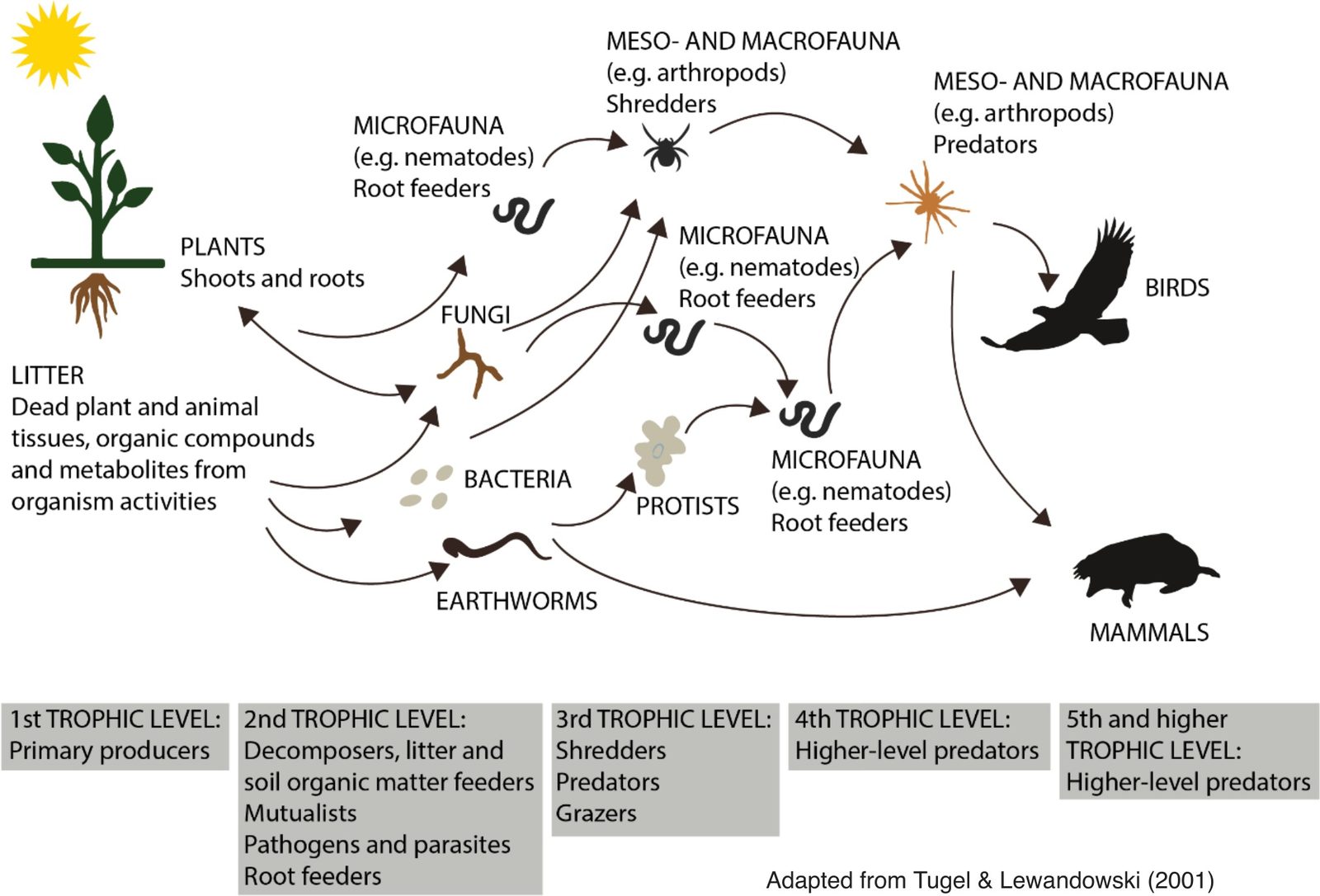
© Soil biota form complex food webs that sustain ecosystem functions, from Common ground: Restoring land health for sustainable agriculture by IUCN.
Text version
Diagram of a soil food web. Organisms are joined by arrows, with plants and litter on the left and birds and mammals on the right. A sun shines above the plant.
Arrows, group by group:
- PLANTS, Shoots and roots: a two-way arrow with FUNGI, and an arrow to MICROFAUNA (e.g. nematodes) Root feeders (top group).
- LITTER, Dead plant and animal tissues, organic compounds and metabolites from organism activities: arrows to FUNGI, BACTERIA and EARTHWORMS.
- FUNGI: arrows to MESO- AND MACROFAUNA (e.g. arthropods) Shredders, and to a second MICROFAUNA (e.g. nematodes) Root feeders group (middle).
- BACTERIA: an arrow to the Shredders.
- From between BACTERIA and EARTHWORMS: one arrow to PROTISTS and one long arrow to MAMMALS.
- Top microfauna group: an arrow to the Shredders.
- Middle microfauna group and PROTISTS: arrows to a third MICROFAUNA (e.g. nematodes) Root feeders group (bottom).
- Shredders and the bottom microfauna group: arrows to MESO- AND MACROFAUNA (e.g. arthropods) Predators.
- Predators: arrows to BIRDS and to MAMMALS.
Trophic levels (grey boxes along the bottom, left to right):
- 1st TROPHIC LEVEL: Primary producers
- 2nd TROPHIC LEVEL: Decomposers, litter and soil organic matter feeders; Mutualists; Pathogens and parasites; Root feeders
- 3rd TROPHIC LEVEL: Shredders; Predators; Grazers
- 4th TROPHIC LEVEL: Higher-level predators
- 5th and higher TROPHIC LEVEL: Higher-level predators
Adapted from Tugel & Lewandowski (2001)
Watch the short, animated video “The Soil Food Web” (external content), which illustrates soil organisms and the connections between them using clay characters. The video was produced by Maxwell Helmberger in cooperation with the Cornell University Department of Entomology Extension/Outreach Assistantship programme and is approximately 90 seconds long.