2.2 — Soil components & DIY soil testing
Soil structure: a hidden architecture
Página 3 / 3
Forum/Soil Diary task
In the previous sections, you learned about soil components (minerals, organic matter, water, and air) and how their arrangement forms soil structure – aggregates and pore spaces that create a living habitat below ground. Now it is your turn to visualise this hidden system.
Draw your own soil profile that shows not only soil horizons but also soil structure. Once you have finished, you can share it in the Forum or document it in your Soil Diary. You may draw by hand or digitally.
Your drawing can be simple or detailed – the goal is to think scientifically, not artistically. Include:
- At least two or three soil horizons (e.g., topsoil, subsoil, parent material)
- Soil aggregates (small clusters of particles)
- Different pore sizes (large and small pores)
- Roots growing through the soil
- Water in some pores and air in others
- At least a few soil organisms (e.g., earthworms, fungi, microorganisms)
If you want, you can follow these guiding questions:
- Where are most organisms located in your profile? Why?
- Where do you place larger pores? Where do you place smaller pores?
- In which direction does water generally move through soil?
- Where is oxygen most available?
- What would happen in your drawing if the soil were compacted?
- How might land management (e.g., vegetation cover, heavy machinery, organic inputs) change your soil structure?
Try to connect your drawing to concepts from the lesson:
- 45 % minerals, 5 % organic matter, 25 % water, 25 % air (in a healthy soil)
- The “city” analogy of buildings (aggregates) and streets (pores)
- The idea that soil structure determines whether life thrives or struggles
Bonus: For inspiration, have a look at this Figure from an article by Erktan et al. (2020) and reflect on how soil structure influences life in soil.
Tip: Learn more about the soil food web and soil organisms in Module 2, Topic 3.
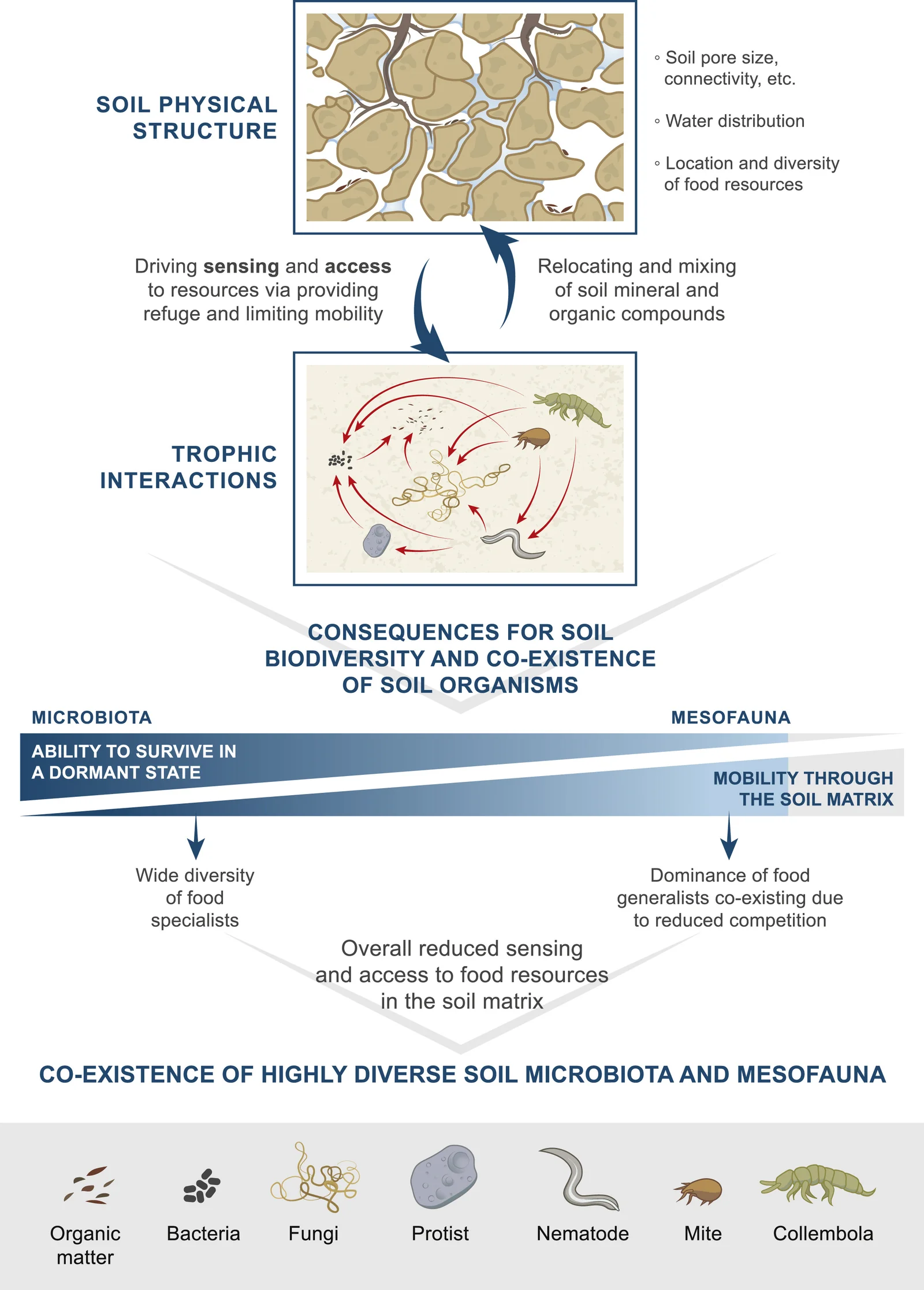
© Effects of soil physical structure on trophic interactions and consequences for soil biodiversity, Erktan et al. (2020), CC BY-NC-ND 4.0, no changes were made to the original figure.
Text version
SOIL PHYSICAL STRUCTURE: drawing of soil aggregates with roots and water-filled pores between them. Next to it:
- Soil pore size, connectivity, etc.
- Water distribution
- Location and diversity of food resources
An arrow down to the trophic interactions reads: “Driving sensing and access to resources via providing refuge and limiting mobility”. An arrow back up reads: “Relocating and mixing of soil mineral and organic compounds”.
TROPHIC INTERACTIONS: red arrows link the organisms:
- from collembola to bacteria, fungi and nematode
- from mite to bacteria, fungi and nematode
- from nematode to bacteria, fungi and protist
- from protist to bacteria
- from bacteria and from fungi to organic matter
This leads to CONSEQUENCES FOR SOIL BIODIVERSITY AND CO-EXISTENCE OF SOIL ORGANISMS. Two opposing wedges run between MICROBIOTA (left) and MESOFAUNA (right): “ABILITY TO SURVIVE IN A DORMANT STATE” is widest at the microbiota end, “MOBILITY THROUGH THE SOIL MATRIX” is widest at the mesofauna end.
- Microbiota end, arrow down to: “Wide diversity of food specialists”
- Mesofauna end, arrow down to: “Dominance of food generalists co-existing due to reduced competition”
Both, together with “Overall reduced sensing and access to food resources in the soil matrix”, converge on: CO-EXISTENCE OF HIGHLY DIVERSE SOIL MICROBIOTA AND MESOFAUNA.
Icon key: Organic matter, Bacteria, Fungi, Protist, Nematode, Mite, Collembola.