1.5 — Culture
Soils are archives of the past
Page 2 / 6
Terra Preta: the black soil
One remarkable example of long-term human influence on soils is Terra Preta (“dark earth”) in the Amazon region of South America. These unusually fertile, dark-coloured soils were influenced over centuries by Indigenous communities through the accumulation of charcoal, food residues, ash, pottery fragments, and organic waste. Unlike many surrounding tropical soils, Terra Preta remains highly fertile even today, demonstrating that humans can not only degrade soils, but also actively improve them over generations.
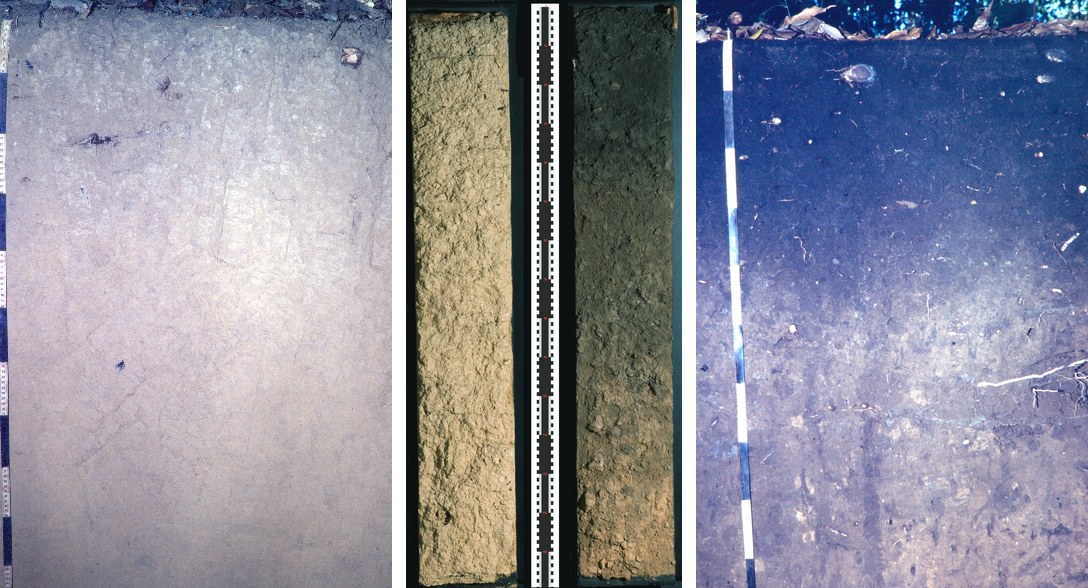
© Soil profiles – vertical sections of soil below the surface – before (left, middle left) and after alteration to Terra Preta (middle right, right) by ISRIC – World Soil Information. The black and white parts of the measuring tape represent 10 cm intervals each.
Researchers believe that Terra Preta formed over long periods through everyday human activities such as cooking, settlement, farming, and waste disposal. Charcoal from low-temperature fires, ash, food remains, plant materials, and broken pottery gradually accumulated in the soil and created stable, nutrient-rich layers. Unlike many tropical soils that lose nutrients quickly, Terra Preta can remain fertile for centuries. This is an important example of how human soil management can create long-lasting environmental legacies.
Today, Terra Preta is studied not only by archaeologists and soil scientists but also as an example of long-term sustainable soil management. It highlights the importance of Indigenous knowledge and demonstrates that soils are not only natural systems but also part of cultural history and human innovation.
For more insights into and pictures related to Terra Preta, we refer to the article by Soentgen et al. (2017) or Schmidt et al. (2023).