2.3 — Soil biodiversity
Life in the soil food web
Pagina 7 / 8
Why does soil biodiversity matter?
From earthworms digging tunnels to fungi forming underground networks, every organism in the soil food web has its own ecological role. Some fragment organic matter, others decompose it; some regulate microbial populations, while others transport nutrients or create habitats for neighbouring organisms. Together, these interactions drive essential soil processes such as decomposition, nutrient cycling, carbon storage, and the formation of healthy soil structure.
The functioning of soils therefore depends not only on the presence of individual species but also on the diversity of organisms and the connections between them. A rich and diverse soil community is generally better able to maintain multiple ecosystem functions and recover from environmental disturbances than a community with fewer species.
Although many soil organisms are invisible to our naked eye, their activities support life above ground every day. Healthy crops, forests, grasslands, and many other ecosystems depend on the countless interactions taking place beneath our feet.
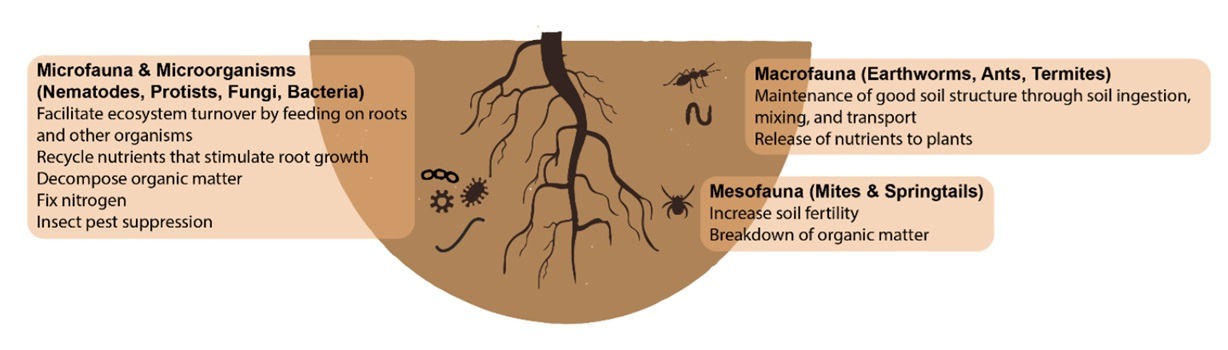
© Overview of ecosystem processes provided by soil biota, classified according to their body size by IUCN (2020) in Common ground: Restoring land health for sustainable agriculture.