2.4 — Soil diversity across land covers
Soil diversity and land covers
Page 3 / 6
Natural and semi-natural grasslands
Before reading the text below, imagine yourself in spring or late summer, with some spare time, walking barefoot across a meadow. Imagine feeling the grass and soil beneath your feet. Have you ever wondered what the soil beneath grassland looks like?
What are natural and semi-natural grassland soils like?
Grasslands occur in almost all biomes and climatic regions, so their soil properties can vary considerably. These soil properties are influenced not only by climate and environmental conditions, but also by vegetation, soil type and management practices. It is therefore only possible to describe broad patterns, listed below. The grasslands considered here are either managed extensively, under low-intensity regimes, or have not been managed for a long time.
Broad patterns in natural and semi-natural soils:
- Vegetation dominated by perennial grass species
- A thin litter layer may be present at the soil surface
- Grass species have dense rooting systems at the soil surface, with density rapidly decreasing with soil depth.
- The topsoil is rich in organic matter, and therefore darker in colour than the layers below.
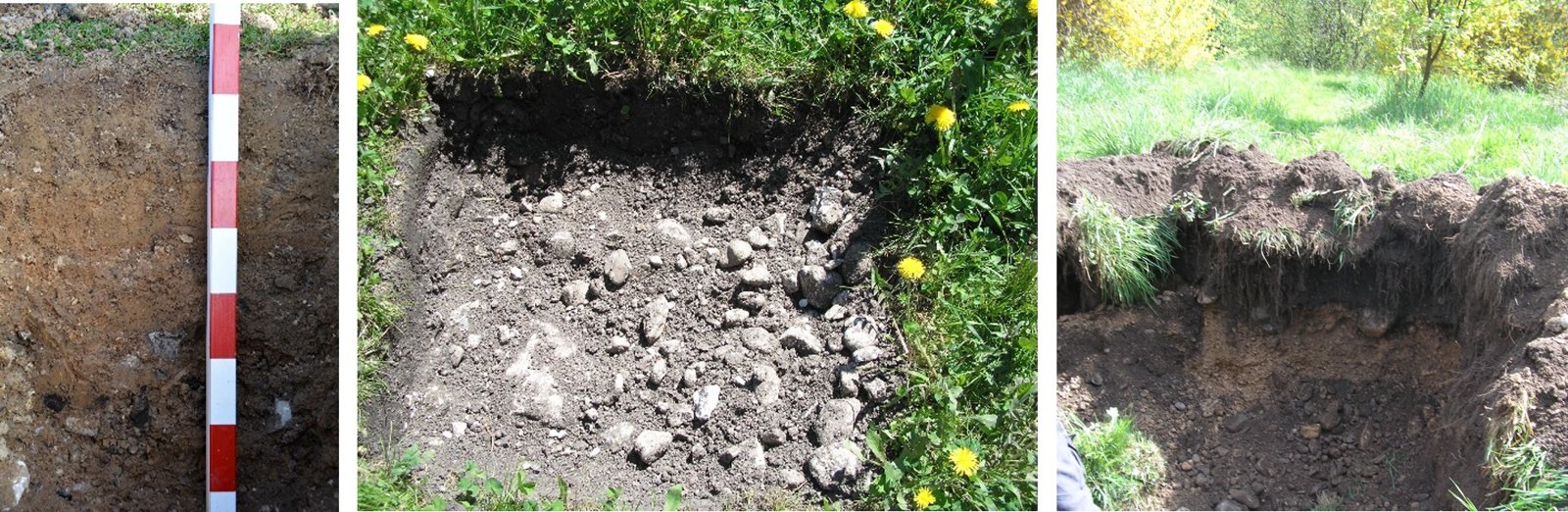
© Grassland soils in Austria by Angelika Hromatka, BOKU University.
If you are interested in reading more about grasslands we recommend recent articles by Lu et al. (2025) focusing on plant roots, or Bai & Cotrufo (2022) about carbon sequestration in grassland soil.