
4.2 — Layers of responsibility: from policy to daily life
From policy to shared responsibility
Page 3 / 5
Why policy regulation alone is not enough
Even robust policy frameworks face practical limits. Enforcement may vary across administrative, geographic, and institutional contexts, while economic pressures continue to shape land-use decisions. Soil degradation can also be gradual and difficult to see, and competing priorities such as housing, transport, food production, energy infrastructure, or economic development may influence political attention.
For example, land take and soil sealing continue in many European regions, despite growing awareness of the importance of functioning soils and stronger attention to soil monitoring in Europe (European Environment Agency, 2024). Soil sealing happens when soil is covered by hard surfaces such as buildings, roads, pavements, or parking areas. As the following EEA chart shows, these sealed surfaces have increased across different land uses in the EU-27. This does not mean that policy has no value. It shows that regulation works within broader social, economic, and professional systems.
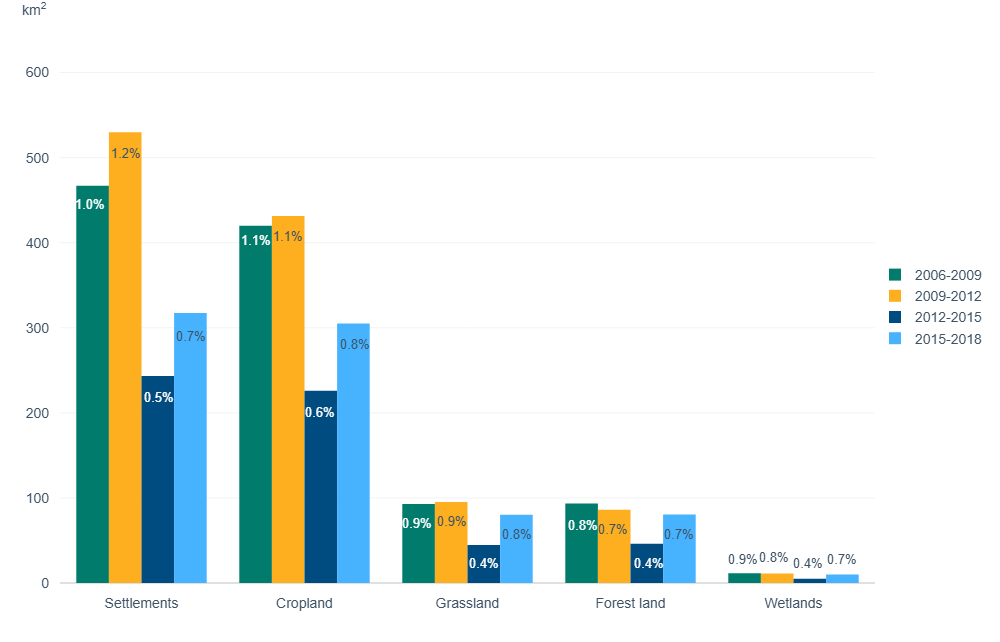
© Imperviousness increase by land use category in EU-27, by European Environment Agency (EEA), CC BY 4.0, no changes were made to the original chart.
Soil protection therefore requires more than rules. It also needs implementation capacity, public awareness, professional assessment, incentives, participation, and social recognition of soil as a shared resource (Newig & Fritsch, 2009; UNEP, 2019).