
2.4 — Soil diversity across land covers
Peat profiles
Page 1 / 7
Peat formation
In the previous lesson, we explored the global, European, and Dutch distribution of peatlands. We learned that peatlands occur on every continent, that their distribution is strongly influenced by climate, and that peat has played an important role in shaping the Dutch landscape. But how do peatlands actually form, and why are they so diverse?
Peat formation begins when dead plant material accumulates faster than it decomposes. For this to occur, environmental conditions must support both abundant vegetation and permanently wet soils. Waterlogged conditions limit oxygen availability, slowing decomposition and allowing organic matter to build up over time. In flat landscapes with poor drainage, these conditions can persist for centuries or even millennia, resulting in the formation of thick peat deposits.
As briefly introduced in the previous lesson, peatlands are generally classified into two main types: fens and bogs. The difference between them lies primarily in their source of water.
Fens develop in areas where groundwater or surface water accumulates. Because this water has passed through mineral soils, it contains nutrients and dissolved minerals. Fens are therefore relatively nutrient-rich and have acidity that is basic, neutral, or slightly acidic. They often support diverse vegetation, including reeds, sedges, willows, and alder woodland.
Bogs, on the other hand, receive water exclusively from rainfall. Rainwater contains very few nutrients, making bogs nutrient-poor and acidic environments. Under these conditions, Sphagnum mosses often dominate. Over time, these mosses can build thick peat layers that rise above the surrounding landscape, creating the raised bogs that once covered large parts of the Netherlands.
These differences in hydrology strongly influence which plants grow in a peatland and, ultimately, the type of peat that forms. Because environmental conditions determine which plants grow and which peat accumulates, peat layers preserve a record of past environmental change. Changes in hydrology, nutrient availability, or vegetation can therefore be identified in peat profiles, allowing us to reconstruct the history of peatland development.
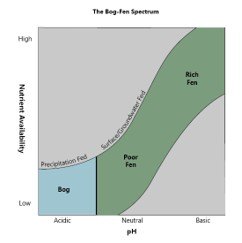
The Bog-Fen Spectrum of nutrient availability and pH for peatlands. © 2026 Betheme by Muffin group.
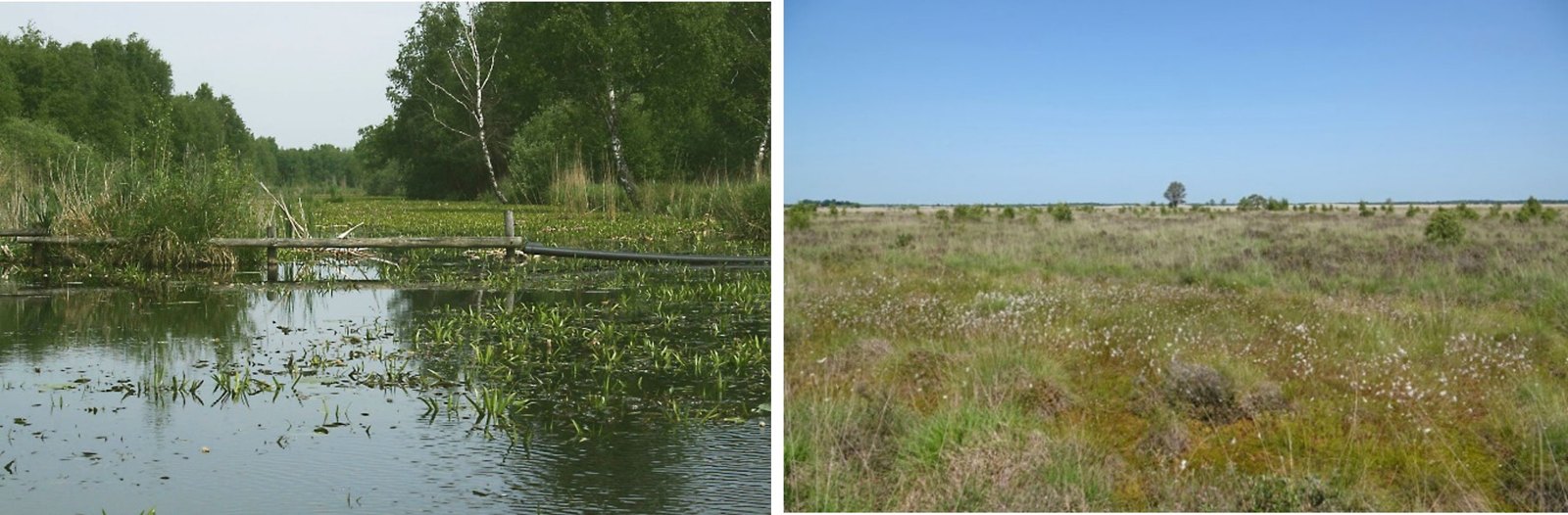
Left: Example of a fen occurring in the low-lying peatlands of the Netherlands. © Guido Keijl, Naturalis. Link:
Right: The Fochteloerveen, a raised-bog where Sphagnum mosses are actively growing, and a Natura 2000 area in the Netherlands. © Marcel Post, Natuurgebiedeninbeeld. Link: