2.3 — Soil biodiversity
The hidden network of soil life: Understanding the soil food web
Page 2 / 3
The Underground Menu: Who eats whom?
The many organisms living in soil do not exist in isolation. They are linked through various feeding relationships and other interactions that together form the soil food web. As with food webs above ground, the soil food web shows how energy and nutrients move through an ecosystem. Unlike many above-ground food webs, however, much of the activity in soils begins with the decomposition of dead organic matter.
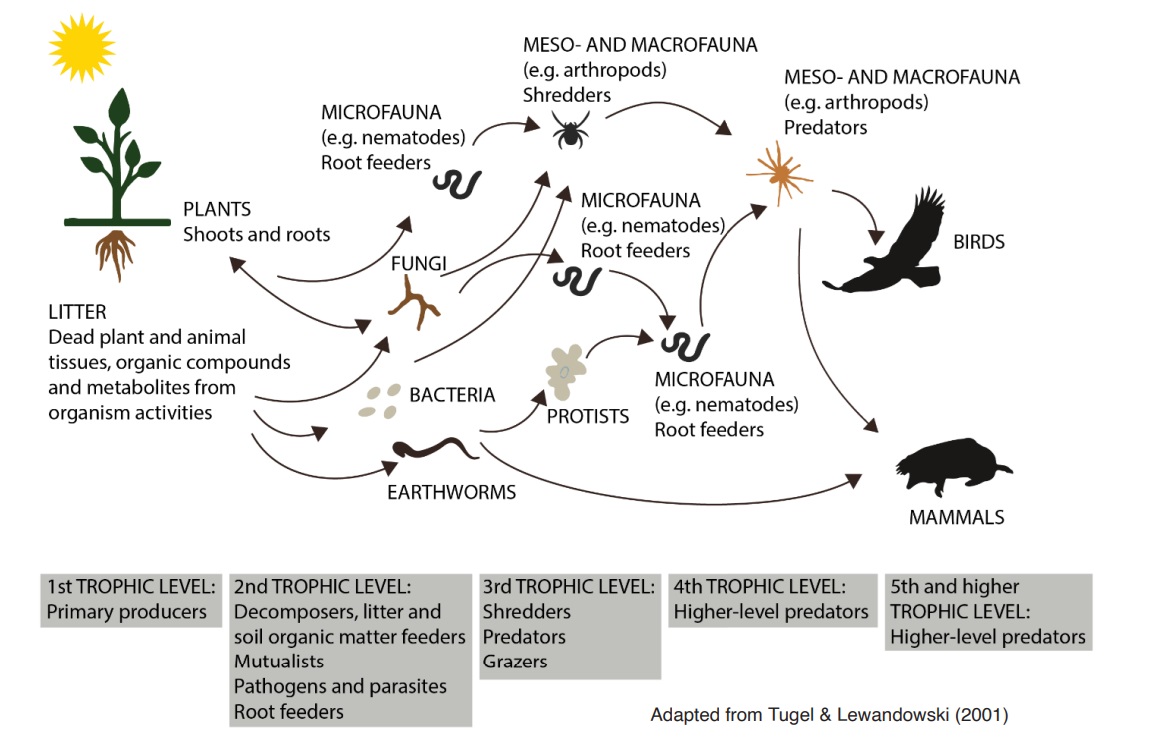
© Soil biota form complex food webs that sustain ecosystem functions, from Common ground: Restoring land health for sustainable agriculture by IUCN.
Text version
Diagram of a soil food web. Organisms are joined by arrows, with plants and litter on the left and birds and mammals on the right. A sun shines above the plant.
Arrows, group by group:
- PLANTS, Shoots and roots: a two-way arrow with FUNGI, and an arrow to MICROFAUNA (e.g. nematodes) Root feeders (top group).
- LITTER, Dead plant and animal tissues, organic compounds and metabolites from organism activities: arrows to FUNGI, BACTERIA and EARTHWORMS.
- FUNGI: arrows to MESO- AND MACROFAUNA (e.g. arthropods) Shredders, and to a second MICROFAUNA (e.g. nematodes) Root feeders group (middle).
- BACTERIA: an arrow to the Shredders.
- From between BACTERIA and EARTHWORMS: one arrow to PROTISTS and one long arrow to MAMMALS.
- Top microfauna group: an arrow to the Shredders.
- Middle microfauna group and PROTISTS: arrows to a third MICROFAUNA (e.g. nematodes) Root feeders group (bottom).
- Shredders and the bottom microfauna group: arrows to MESO- AND MACROFAUNA (e.g. arthropods) Predators.
- Predators: arrows to BIRDS and to MAMMALS.
Trophic levels (grey boxes along the bottom, left to right):
- 1st TROPHIC LEVEL: Primary producers
- 2nd TROPHIC LEVEL: Decomposers, litter and soil organic matter feeders; Mutualists; Pathogens and parasites; Root feeders
- 3rd TROPHIC LEVEL: Shredders; Predators; Grazers
- 4th TROPHIC LEVEL: Higher-level predators
- 5th and higher TROPHIC LEVEL: Higher-level predators
Adapted from Tugel & Lewandowski (2001)
At the base of the food web, microorganisms – such as bacteria, archaea, and fungi – break down plant and animal remains. During decomposition, nutrients are released and transformed into forms that become available to other organisms, including plants. Many fungi form extensive networks of microscopic filaments called hyphae, which transport water and nutrients through the soil. Mycorrhizal fungi live in close association with plant roots, supplying plants with nutrients and water in exchange for sugars produced through photosynthesis.
Microfauna and mesofauna, such as protozoa, nematodes, mites, and springtails, feed on microorganisms and on each other. By grazing on microbial communities, they recycle nutrients and influence microbial activity. Larger organisms, including earthworms and termites, mix organic and mineral material, create pores and tunnels, and modify the physical structure of soils. Predators such as centipedes and beetles help regulate populations of smaller soil animals.
Together, these interactions create a dynamic network that continually transfers energy and matter throughout the soil ecosystem. Rather than acting independently, soil organisms depend on one another through complex feeding relationships and ecological interactions, making the soil food web one of the key foundations of healthy, resilient and functioning soils (Bardgett & van der Putten, 2014; de Vries et al., 2013).
For a more vivid visualisation of the soil food web, visit a Swedish forest by watching the video “59 Degrees Academy: the Soil Food Web”. It was produced by 59 Degrees Academy and is approximately 7 minutes long.