1.3 — Regulation
Soil regulates the water cycle: A natural sponge and filter
Page 2 / 6
Following the journey of rainwater
Water is continuously circulating through the Earth's water cycle. It evaporates from oceans, lakes, rivers, soil, and other wet surfaces, while plants release water to the atmosphere through transpiration. As the water vapour rises and cools, it condenses into clouds. Eventually, it returns to the surface as rain, snow, or another form of precipitation, continuing its journey through the environment.
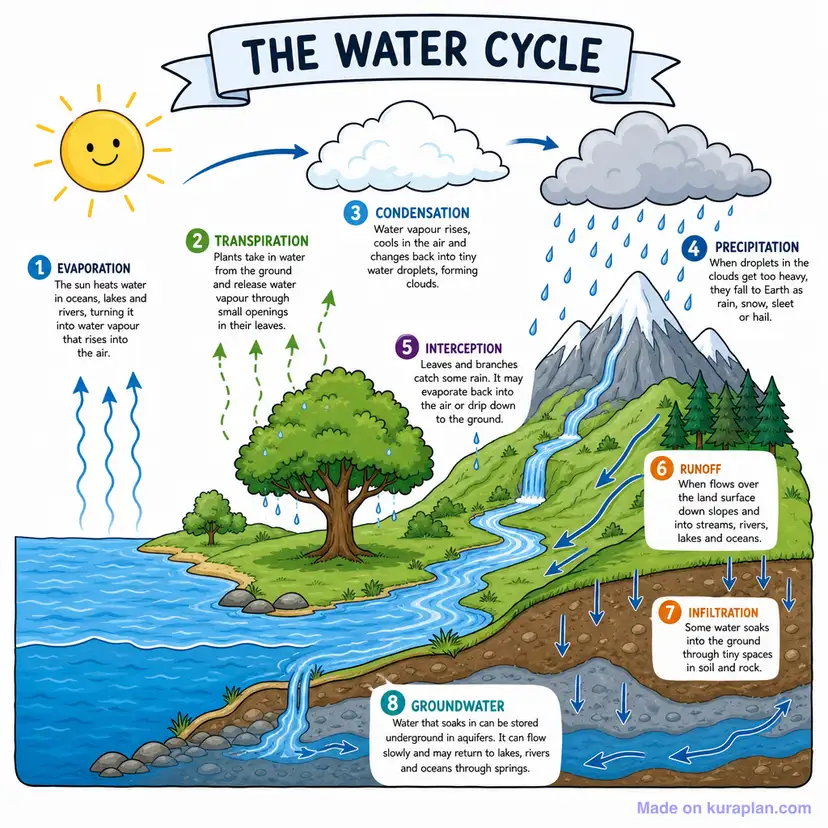
© Water cycle diagram image by Kuraplan, CC BY-NC 4.0, no changes were made to the original image.
Once water has infiltrated the soil, its journey is far from over. It becomes part of a dynamic system in which water is continuously stored, transported, and exchanged between soil, plants, groundwater, and atmosphere.
Water moves through the interconnected network of soil pores under the influence of gravity and capillary forces. Some of it is retained within the soil, where it becomes available to plant roots. Plants absorb this water together with dissolved nutrients and transport it to their leaves, where much of it returns to the atmosphere through transpiration. At the same time, water can evaporate directly from the soil surface. Together, these processes are known as evapotranspiration and form an essential link between soils, vegetation, and the atmosphere.