
The Whole School Approach
Challenges + practical tips
Page 1 / 1
Challenges + practical tips
Challenges:
Community outsiders: Professionals may lack community integration; mutual cultural understanding is needed.
Social class: Aim for equity but integrate diverse social groups.
Digital: Question virtual community effectiveness in WSAs.
Sustainability: WSA processes are sensitive to change; long-term sustainability is complex.
Participation: Crucial for WSA; requires reformulating participation, reconstructing spaces, and rethinking strategies to enhance stakeholder involvement.
Practical tips:
Integrate soil education across curricula (science, geography, art).
Create outdoor learning spaces — school gardens, composting areas.
Engage the community — local experts, farmers, environmental organizations.
Host interactive workshops for students, parents, and staff.
Develop student-led projects.
Incorporate technology — virtual soil collections, soil-health apps, interactive maps.
Establish a soil literacy committee with diverse input.
Regularly evaluate and adapt based on feedback and changing educational needs.
Whole school approach to soil education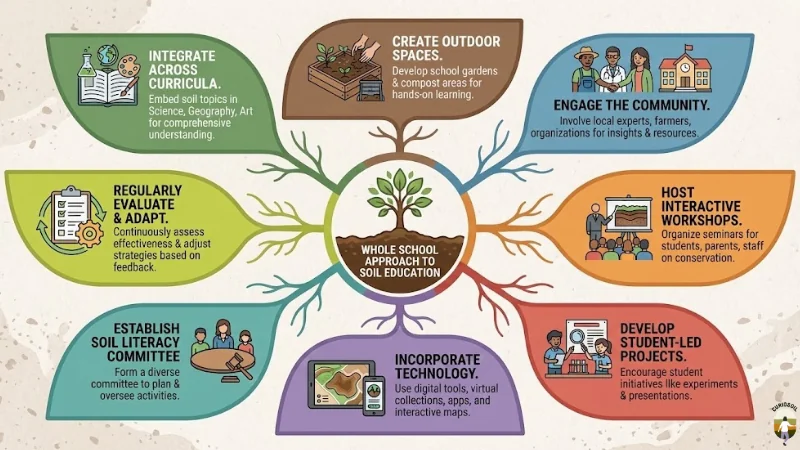
Text version
Check out this MOOC to learn more about Teaching Sustainability Awareness from a whole systems perspective