
Risk management
7 questions to scope your project risks
Page 1 / 1
7 questions to scope your project risks
Empowered teams need guardrails. Risk Management, tackles the practical realities that keep school heads awake: What if a student is injured in the garden? What if a compost project triggers parent complaints? We'll translate anxiety into action, developing checklists for liability, crafting communication templates for controversies, etc.
When thinking about implementing a soil literacy project, it is helpful to reflect on risk management. Answer the following questions and write a summary of your thoughts.
1. Project Overview: What are the main objectives of your soil literacy project? Who are the key stakeholders involved?
2. Risk Identification: What potential risks could affect the implementation (financial, operational, technical, environmental)? Weather conditions or environmental changes that could impact the project?
3. Impact Assessment: Which risks are most likely to occur, and what would be their impact? How would these risks affect the different stakeholders involved?
4. Risk Mitigation Strategies: What strategies can be implemented to minimize the likelihood and impact? How can the project be adapted if such risks cannot be fully prevented?
5. Resource Allocation: What resources (financial, human, material, and operational such as workspace + safety equipment) are required to manage these risks? How will you ensure risk management is a continuous process?
6. Communication Plan: How will you efficiently communicate risks and mitigation strategies to stakeholders? Who will be responsible for disseminating updates?
7. Evaluation and Review: How will you evaluate the effectiveness of your risk management strategies? What process will you use to review and update plans?
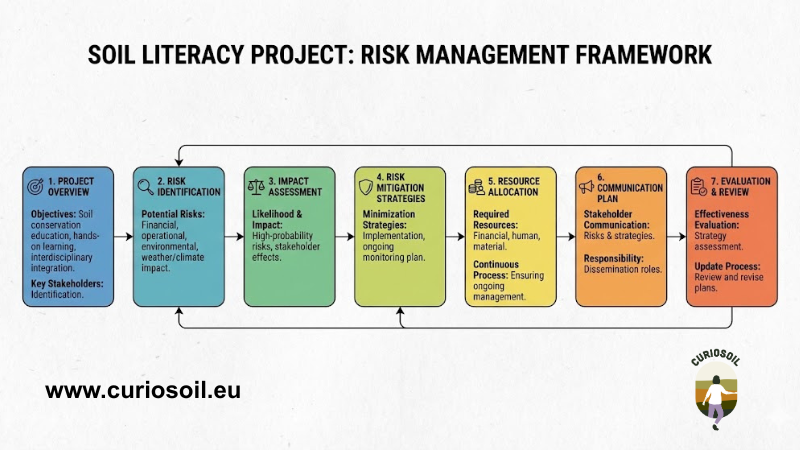
Text version
Soil literacy project: risk management framework
- Project overview
- Objectives: Soil conservation education, hands-on learning, interdisciplinary integration.
- Key Stakeholders: Identification.
- Risk identification
- Potential Risks: Financial, operational, environmental, weather/climate impact.
- Impact assessment
- Likelihood & Impact: High-probability risks, stakeholder effects.
- Risk mitigation strategies
- Minimization Strategies: Implementation, ongoing monitoring plan.
- Resource allocation
- Required Resources: Financial, human, material.
- Continuous Process: Ensuring ongoing management.
- Communication plan
- Stakeholder Communication: Risks & strategies.
- Responsibility: Dissemination roles.
- Evaluation & review
- Effectiveness Evaluation: Strategy assessment.
- Update Process: Review and revise plans.
www.curiosoil.eu