3.4 — Peatland degradation
Threats to peatlands
Page 2 / 6
From peatland to agricultural landscape
The rise and decline of the Dutch peatlands
In Peat Cover Stories (Module 2), we followed the natural development of peatlands in the Netherlands over thousands of years. By the Middle Ages, extensive peatlands covered large parts of the country. In the western Netherlands, thick peat deposits had developed behind the coastal barriers and along the major rivers. Around 1000 years ago, however, a new force increasingly began to impact this landscape: people.
From around the 10th century onwards, people increasingly settled and cultivated the peatlands. To make these naturally wet areas suitable for agriculture, long drainage ditches were dug into the peat. Water drained from the land into these ditches and eventually towards rivers and other waterways. This reclamation created the characteristic pattern of long, narrow fields that can still be recognised throughout the western Dutch peat meadow landscape today.
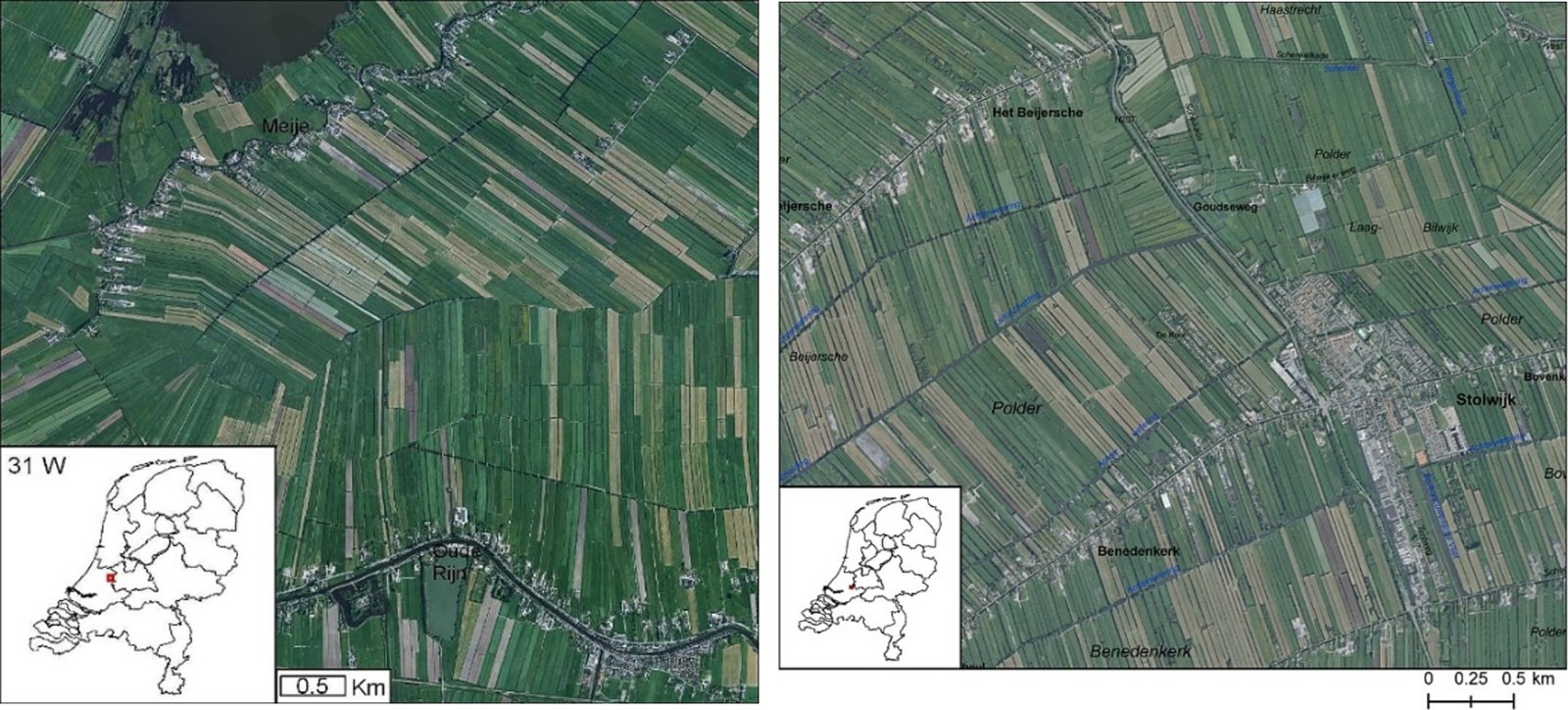
Left: © Aerial photograph showing the cope reclamation landscape; the long narrow parcels stretching up from the former peat river ‘Meije’ and the river ‘Oude Rijn’, which is an old branch of the Rhine river. Landschappen van Nederland.
Right: © Aerial photograph showing linear settlements along created embankments. Landschappen van Nederland.
Drainage made agriculture and settlement possible, but it also had an unintended consequence. Remember how peat forms: under waterlogged conditions, a lack of oxygen slows decomposition and allows dead plant material to accumulate.
What happens when the water table is lowered? Part of the peat that was previously saturated with water becomes exposed to air. Two important processes then cause the land surface to subside. First, the peat shrinks and compacts as water is removed and the weight of the overlying soil compresses the peat. Second, oxygen enters the drained peat, allowing microorganisms to decompose the organic matter. This process, known as peat oxidation, means that some of the peat literally disappears as its carbon is converted mainly into CO₂. This combination of settling, shrinkage and microbial decomposition is the fundamental reason why drained Dutch peat soils subside.