
1.6 Soils in a connected world
Synthesis: The case of peat
Seite 3 / 8
The regulating services of peatlands
Regulating services summarize all the processes in peatlands which contribute to the maintenance of a healthy environment by providing clean air, water and soil. One of the most important soil services provided by peatlands is the regulation of the global climate. Peatlands are major long-term carbon sinks. Peatlands influence the climate mainly through their role in the global carbon cycle and through the exchange of greenhouse gases with the atmosphere.
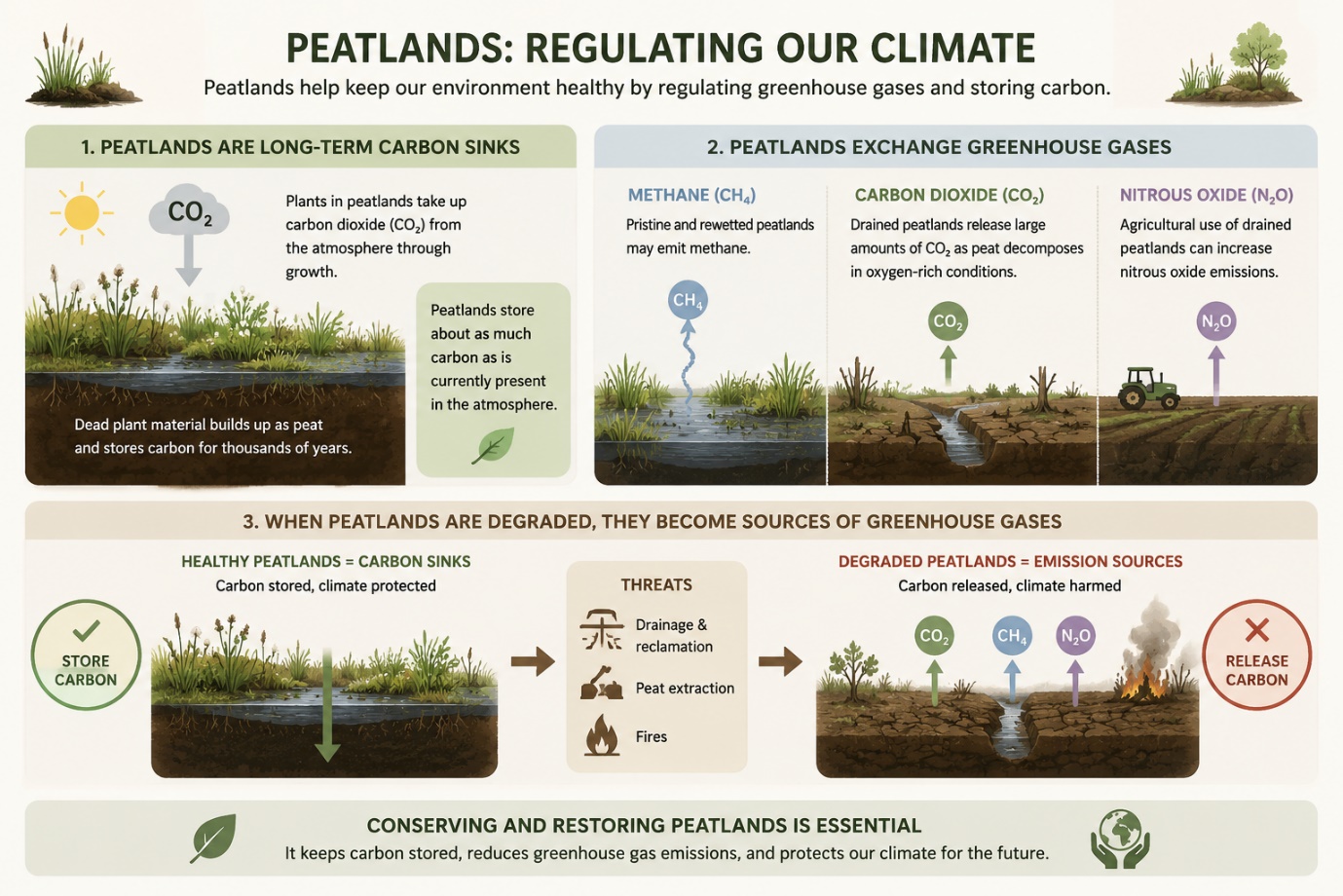
AI-generated infographic explaining how healthy peatlands act as long-term carbon sinks.
Text version
PEATLANDS: REGULATING OUR CLIMATE
Peatlands help keep our environment healthy by regulating greenhouse gases and storing carbon.
1. PEATLANDS ARE LONG-TERM CARBON SINKS
Plants in peatlands take up carbon dioxide (CO₂) from the atmosphere through growth. (Picture: an arrow from a CO₂ cloud down into a wet, vegetated peatland.) Dead plant material builds up as peat and stores carbon for thousands of years. Peatlands store about as much carbon as is currently present in the atmosphere.
2. PEATLANDS EXCHANGE GREENHOUSE GASES
- METHANE (CH₄): Pristine and rewetted peatlands may emit methane. (Picture: CH₄ rising from a wet peatland.)
- CARBON DIOXIDE (CO₂): Drained peatlands release large amounts of CO₂ as peat decomposes in oxygen-rich conditions. (Picture: CO₂ rising from dry, cracked peat cut by a drainage ditch.)
- NITROUS OXIDE (N₂O): Agricultural use of drained peatlands can increase nitrous oxide emissions. (Picture: N₂O rising from a ploughed field with a tractor.)
3. WHEN PEATLANDS ARE DEGRADED, THEY BECOME SOURCES OF GREENHOUSE GASES
Three panels linked by arrows, left to right:
- HEALTHY PEATLANDS = CARBON SINKS: Carbon stored, climate protected. Badge with a tick: STORE CARBON. (Picture: wet, vegetated peatland with an arrow pointing down into the peat.)
- THREATS: Drainage & reclamation; Peat extraction; Fires.
- DEGRADED PEATLANDS = EMISSION SOURCES: Carbon released, climate harmed. Badge with a cross: RELEASE CARBON. (Picture: dry, cracked peat with a ditch and a fire, with CO₂, CH₄ and N₂O rising.)
CONSERVING AND RESTORING PEATLANDS IS ESSENTIAL
It keeps carbon stored, reduces greenhouse gas emissions, and protects our climate for the future.