1.4 — Support
Soil as living ecosystem supporting all other services
Seite 1 / 7
Thought experiment: a fallen leaf
Imagine a forest floor covered with fallen leaves. What would happen if only a single species of bacterium lived in the soil beneath it? Could that organism alone decompose all plant material, release nutrients, create soil structure, support plant growth, and respond to changing environmental conditions?
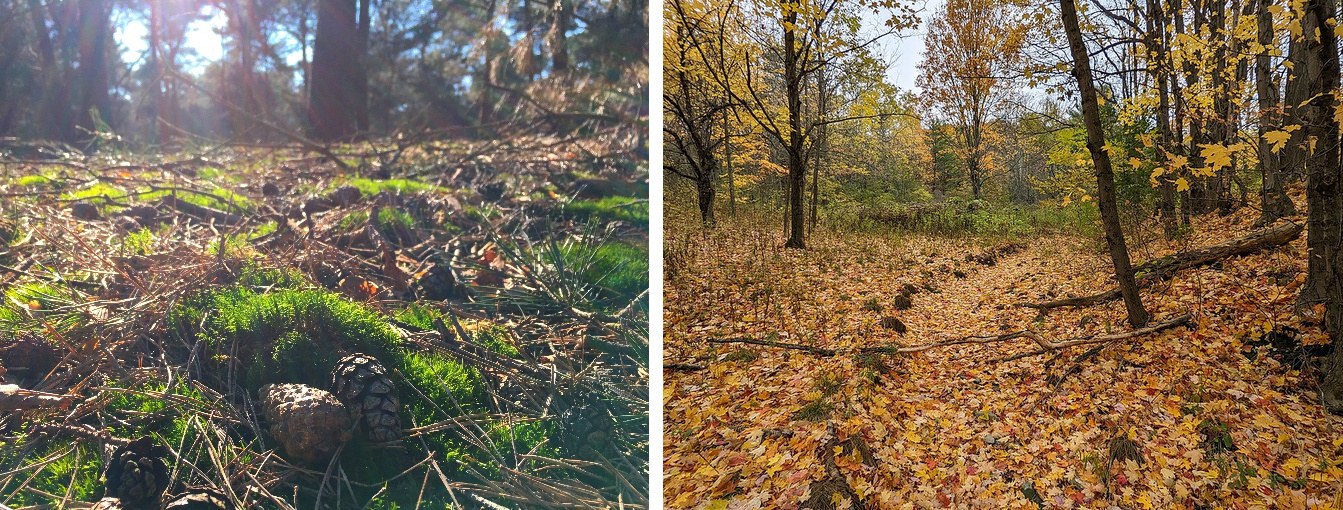
Left: © Forest floor by Industrees, CC0
Right: © A forest trail covered in newly fallen leaves by usfs_Eastern_Region, CC0
Probably not.
Many of the processes that make soils productive and resilient emerge because countless organisms interact with one another. Soil functions are therefore not simply the result of individual species acting alone; they arise from the combined activities of entire communities.
In the previous lesson, we explored some of the interactions that connect soil organisms. In this lesson, we take the next step and ask why these interactions matter. How do countless small organisms working together create the larger processes that support ecosystems – and, ultimately, many of the soil services on which we depend?