
4.1 — Soil protection & policy
What is soil governance?
Page 1 / 2
What is soil governance?
Soil science helps us understand how soils form, what properties they have, how they function, what role they play in the environment, and how they respond to pressures such as erosion, sealing, contamination, compaction, and loss of organic matter. However, knowledge alone does not protect soil.
Soil protection depends on decisions: how land is used, which practices are supported or restricted, who monitors soil condition, who restores degraded areas, and how competing needs are balanced. These decisions are part of soil governance.
Put simply, soil governance connects what we know about soils with what societies decide to do with that knowledge.
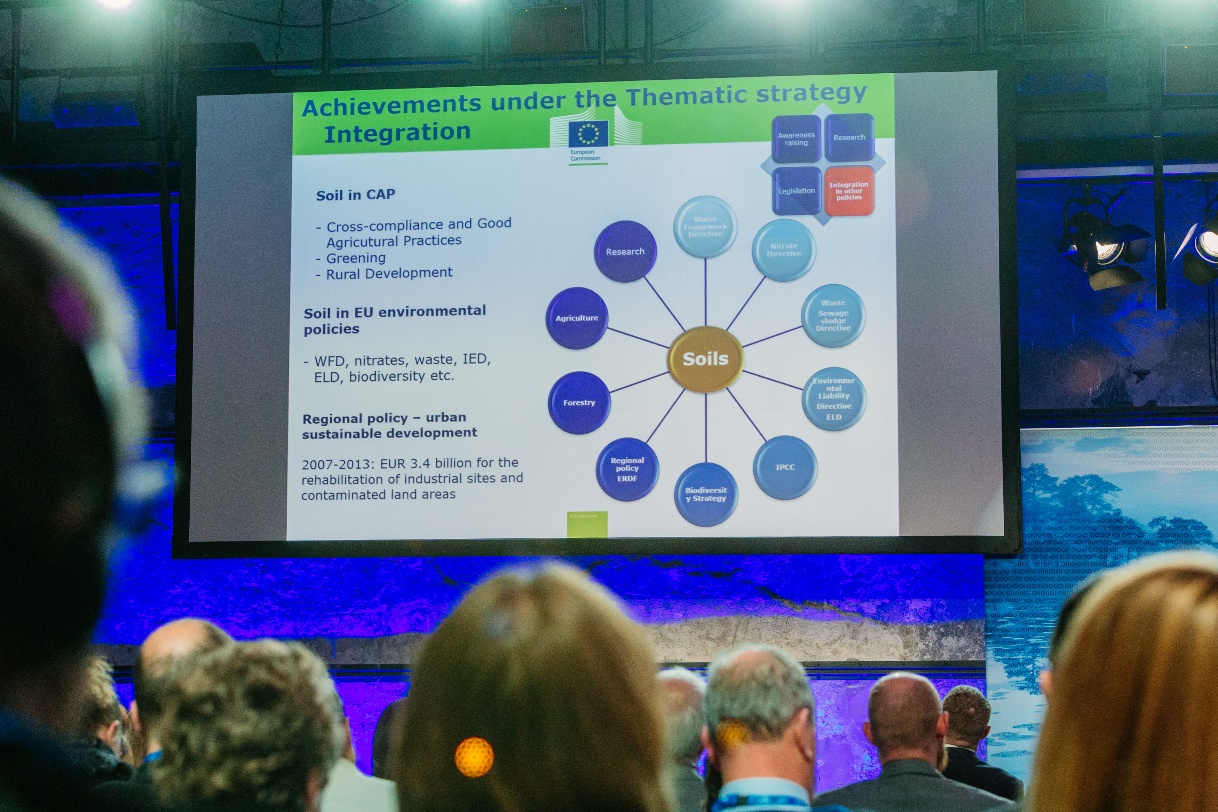
© Soil for sustainable food production and ecosystem services, by EU2017EE Estonian Presidency, CC BY 2.0, via Wikimedia Commons, no changes were made to the original photo.
Heuser provides a more complete definition: “Soil governance refers to the system of formal and informal rules, institutions, policies, and processes by which societies make decisions about the use, management, and protection of soil resources. It encompasses the distribution of rights and responsibilities among different actors and the procedures for making and implementing decisions concerning soils at local, national, and international levels.” (Heuser, 2022)
This means that governance is broader than regulation. Laws and policies are important, but they only become effective when they are supported by institutions, funding, monitoring, enforcement, professional practice, and cooperation with land users. For example, a policy may promote sustainable soil management, but farmers, foresters, planners, and municipalities need practical guidance, resources, and locally relevant information to apply it.
Soil governance can help societies to:
- define responsibilities for soil protection;
- monitor soil condition over time;
- regulate damaging land-use practices;
- support sustainable soil management;
- guide the restoration of degraded or contaminated soils;
- create spaces for public consultation and participation.
At the same time, soil governance is often fragmented. Soil is connected to agriculture, forestry, water management, biodiversity, spatial planning, construction, waste, climate, and public health. As a result, soil protection is often addressed through several laws, policies, and institutions rather than through a single framework.