
1.1 — Soils and Daily Life
Soils are all around us
Page 4 / 8
What are soil services or soil functions?
Soil’s services – also referred to as functions – are diverse and essential. In scientific contexts, the term soil functions is commonly used to describe the natural processes soils perform, such as storing water or cycling nutrients. The term ecosystem services, on the other hand, emphasizes the benefits these processes provide to people (Adhikari & Hartemink, 2016). In this course, we use the term soil services to connect these perspectives and make the concept more accessible.
No matter the terminology, soils are closely connected to human well-being, even though many of us are not aware of it (Moscatelli & Marinari, 2024; Vallejo et al., 2025). We rely on soils for food, shelter, medicine, and much more – all of which ultimately originates from this vital resource.
Have a look at this FAO overview of soil services (or soil functions) to understand how soils influence many aspects of human life.
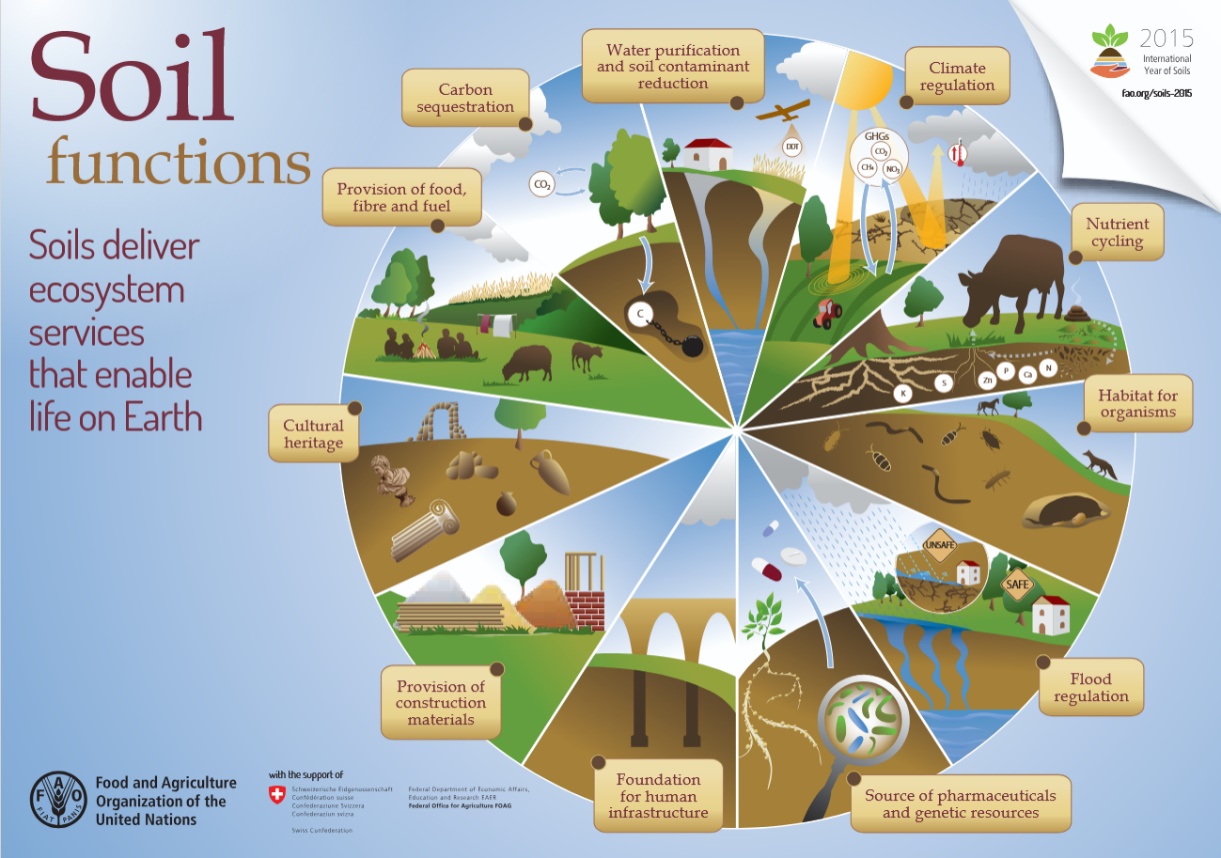
To better grasp the wide range of soil services, we can group them into four main categories: provisioning, regulating, supporting, and cultural services.
The provisioning role includes enabling the growth of crops and forests, providing food, wood, and raw materials.
Through its regulating functions, soil filters and stores water, recycles nutrients, and hosts organisms that help control diseases, decompose waste, and balance gases like carbon dioxide and nitrogen – key processes for climate stability.
Soils also play a supporting role, serving as the physical foundation for buildings, roads, and ecosystems, while giving habitat to countless organisms – from microbes to mammals – that keep the system healthy. Also soil formation processes and microbial transformations of nutrients are considered as supporting services.
Finally, soil carries a deep cultural function, shaping traditions, languages, and identities. History shows that soil and society have shaped one another – from affecting the rise and fall of civilizations and the movement of armies to influencing how cultures and countries formed. Soils further inspire art, religion, and storytelling, reflecting humanity’s long relationship with the ground beneath our feet.
For more examples, you can visit a comprehensive article by Brevik et al. (2018).
Check out this video for a view more specific facts on soil services!

This short video produced by BBC shows you many aspects why we think that soil is amazing. The video takes about 3.5 minutes and summarizes comprehensively various soil services and shows visually strong animations. Click on the video button icon to watch.
Please note: This is an external resource. By clicking the link or play button, you will be redirected to YouTube.
Look out for aspects about soil that are new to you. Can you find some information that is not part of the text you’ve just read?
Feel free to navigate the speed of the video or activate the automatically created subtitles.
Have fun watching!