1.6 Soils in a connected world
Soil, Microbes, and Human Health: One connected system
Page 1 / 6
Life on Earth is connected
In the previous lesson, we explored how a single soil ecosystem – peatlands – can provide many different services at the same time. We saw that soils are multifunctional systems where climate regulation, biodiversity, water storage, and cultural values are closely intertwined.
These functions, however, are not isolated features of peatlands. They are expressions of a much larger reality: soils are embedded in a continuous flow of life and matter that connects ecosystems, organisms, and human societies.
In this lesson, we extend this perspective and ask a deeper question: how is soil connected to life itself – and what does this mean for the health of ecosystems and humans?
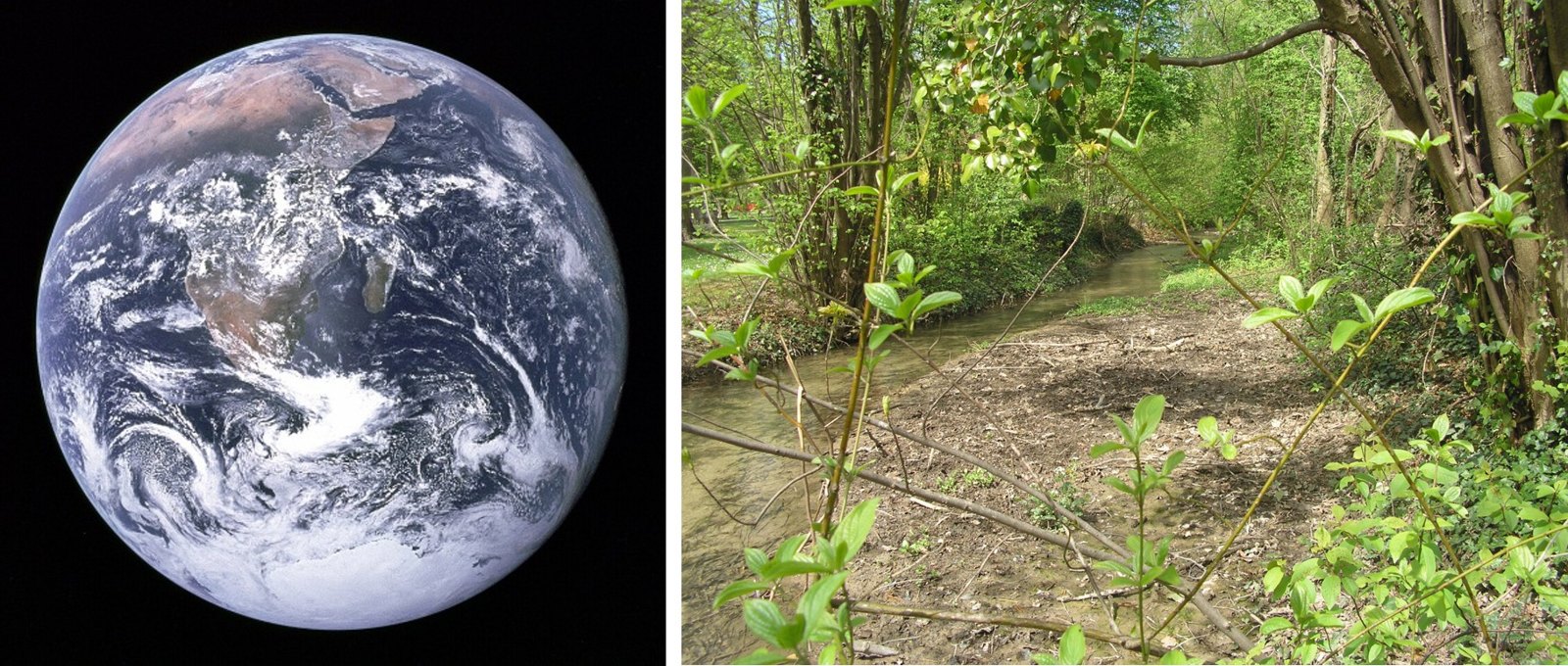
Left: © The Earth seen from Apollo 17/The Blue Marble by Harrison Schmitt or Ron Evans/NASA, public domain
Right: © River landscape by Angelika Hromatka, BOKU University
Earth is not a collection of isolated systems. It is a network of interacting spheres through which energy and matter continuously move. Water cycles between land, oceans, and atmosphere; nutrients circulate through soils, vegetation, and organisms; and gases link biological activity in soils with the composition of the atmosphere.
Soil forms a central interface in these exchanges. It develops where rock, water, air, and living organisms meet, and it constantly mediates their interactions. At the same time, soil is not only a physical or chemical medium, but a living environment shaped by an extraordinary diversity of organisms.
To understand soil in this lesson, we therefore shift the perspective from soil as a system component to soil as a vital link in the chain of life – one which is inseparable from the health of all living beings. This connectivity does not stop at ecosystem boundaries: it extends into the human body itself.