
4.1 — Soil protection & policy
Rules beneath our feet
Page 3 / 6
European Union level
In the European Union, soil has long been addressed through several policy areas, including agriculture, water, waste, chemicals, biodiversity, climate, and land-use planning. These policies have contributed to soil protection, but often in a fragmented way.
The EU Soil Strategy for 2030 marked a stronger step towards a more coordinated soil policy. It set the long-term objective that all soils in the EU should be in healthy condition by 2050.
A further step was the adoption of Directive (EU) 2025/2360 on Soil Monitoring and Resilience, also known as the Soil Monitoring Law. The Directive establishes a common EU framework for assessing and monitoring soil health and resilience. It covers all soil types across the EU, including agricultural land, forests, and urban areas. It also establishes a comprehensive framework focused on soil monitoring, soil health assessment, contaminated site management, sustainable soil management principles, reporting, and data sharing across Member States.
This does not mean that the EU manages every soil directly. The Directive sets common objectives, monitoring requirements, and reporting principles, while Member States remain responsible for implementation within their own legal and institutional systems.
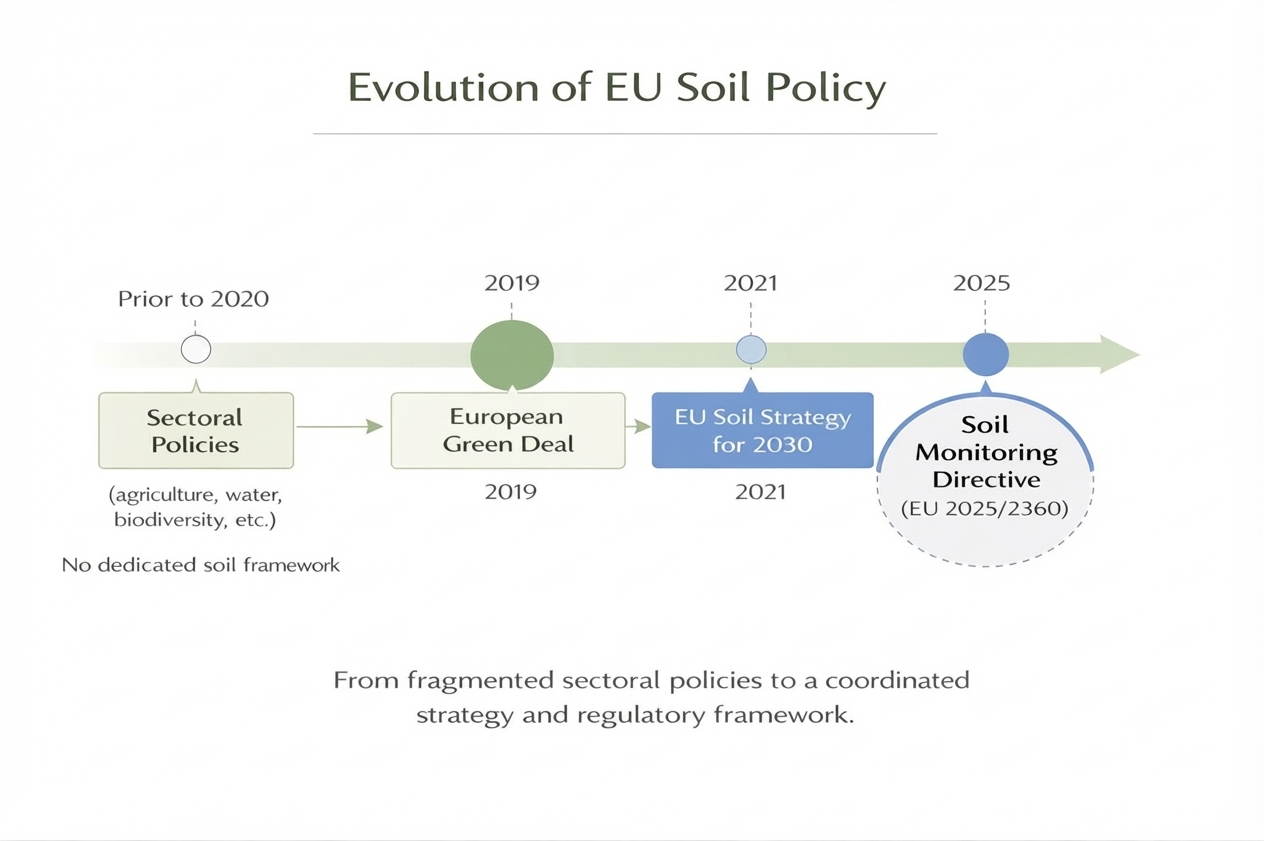
© Scheme of EU soil governance over time from fragmented policies to a coordinated framework, figure developed by Ana Machado, University of Aveiro, with the assistance of AI tool for visual design.